UV index and UV dose: cloud modification -- info on updates
data version 2.x

UV index and UV dose: cloud modification -- info on updates
|
|
| Main data product description page | Main page on cloud modification |
Cloud-modified UV dose data
In order to determine the actual total daily UV dose the attenuation of the UV light due to clouds needs to be accounted for. See for a detailed description of how that is done the main page on cloud modification.
- The impact of updates in the cloud modification factor are discussed on below:
- Change from MSG CPP data version 0001 to version 0002
(21 March 2021 & November 2025), which has two aspects:- Change from MSG to MTG data, as of 1 January 2026
Change from MSG CPP data version 0001 to version 0002
This change, implemented on 22 March 2021, includes several updates of the algorithm. For the cloud-modified UV dose two aspects are most relevant: In November 2025 the CPP algorithm was updated again, affecting the latter of these two aspects.Extension of the field-of-view
The MSG CPP data versions 0001 and 0002 differ in the extend of the actual field-of-view (FOV) of the observations: version 0001 data has θmax = 78° while version 0002 has θmax = 84°.This increase in the solar and satellite zenith angles has two effects:
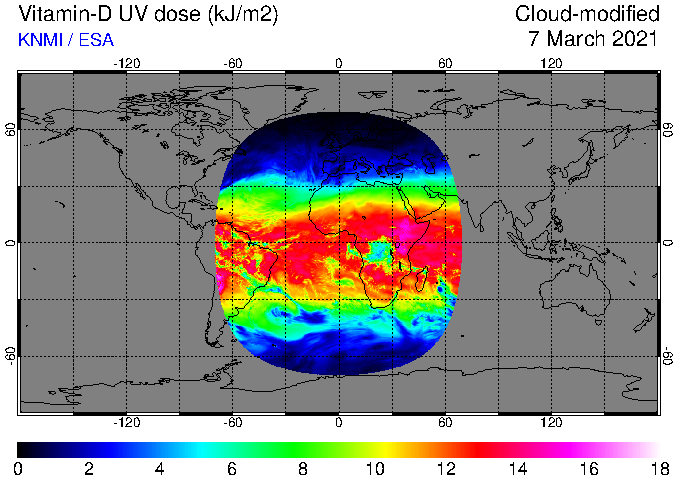
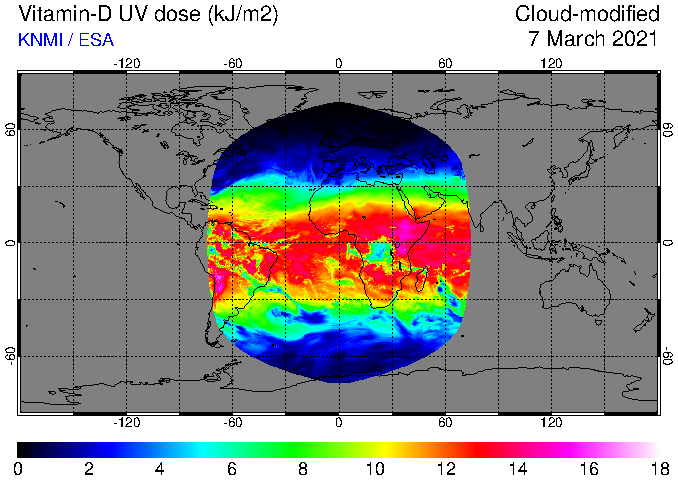
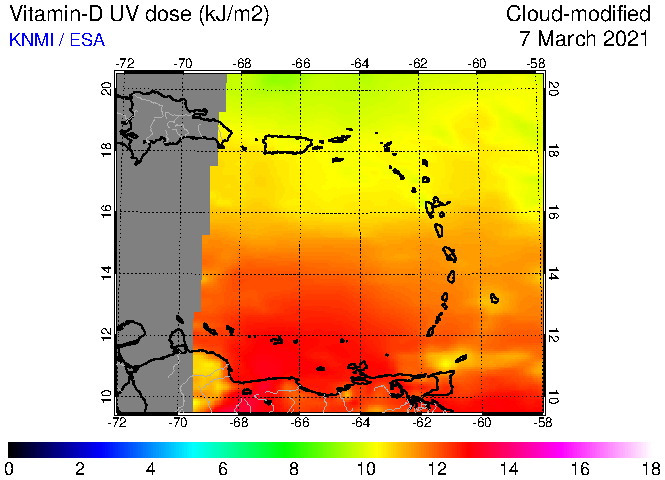
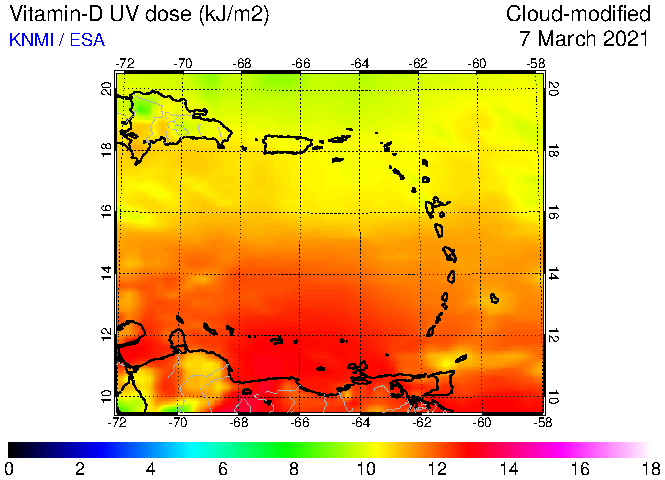
The latter point cannot be seen clearly in the data, due the small impact mentioned. The first point shows up clearly in maps of the cloud-modified UV dose, as can be seen in the following figures. For the TEMIS UV data service for the Dutch Caribbean region this increase of the FOV is of particular interest, as the example figures show.
- Cloud data is available over a larger geophysical area
As a result of this the UV dose data extents further North/South and further East/West: along the equator and along the zero meridian the from about ±69° to about ±74° for the MSG satellite positioned above (longtide,latitude) = (0,0), which is usually the case.
- Cloud data is available over a longer period of time during the day
As a result of this we need extrapolate over a shorter range of time to ScatterRise and ScatterSet, making the daily UV dose values more reliable, although the impact of this will be small as for these periods the Sun is low above the horizon and thus there is little UV light to begin with.
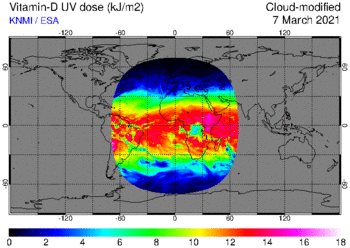
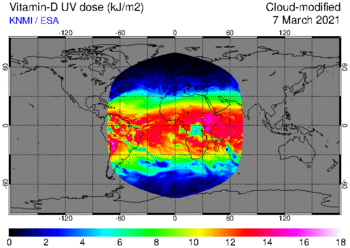
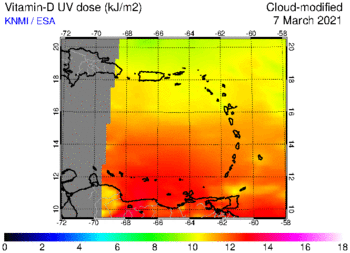
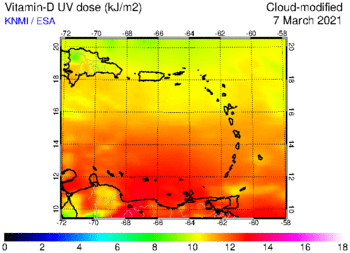
Daily cloud-modified Vitamin-D UV dose for 7 March 2021 for cloud data limit to θmax = 78° (left) and to θmax = 84° (right) for the whole world (top) and the Dutch Caribbean region (bottom). The MSG CPP data versions 0001 and 0002 furthermore differ slightly in the value of both the
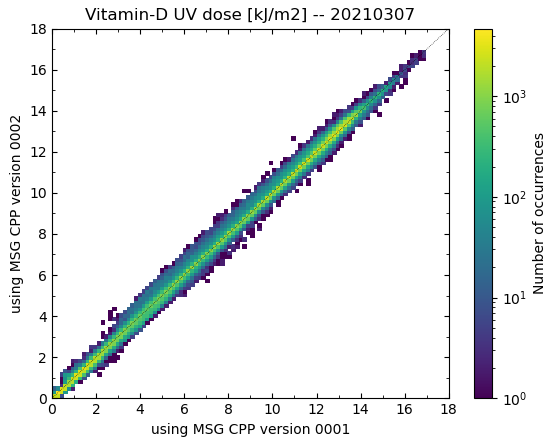
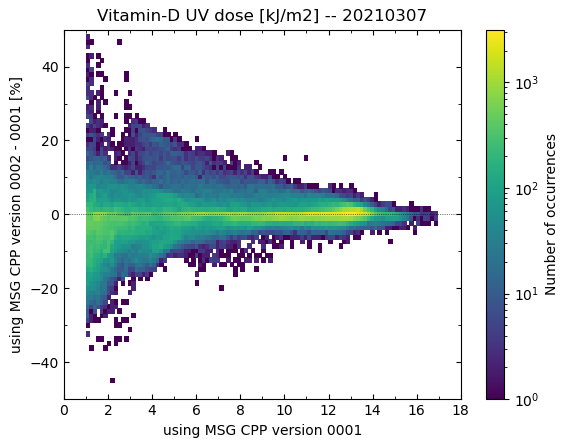
SDSand theSDScsthat make up the cloud modification factor, since there are some changes in the algorithm. This turns out to have some effect on the values of the cloud-modified UV dose, as the following scatter plot shows, ranging from a few percent for the highest UV dose values to 10% for medium values to
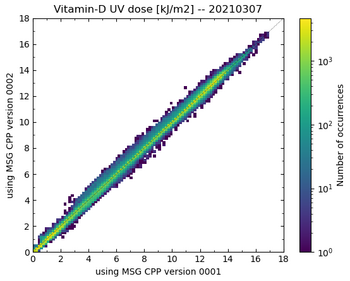
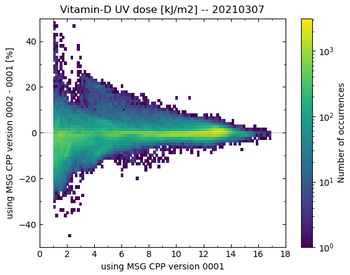
Scatter plots of the cloud-modified vitamin-D UV dose for 7 March 2021 using MSG CPP data of version 0001 along the horizontal axis and along the vrtical axis version 0002 (left) and the relative difference between both versions (right), for the common area of θmax = 78°. In the plot on the right the low UV dose values are omitted because the relative differences may be very large there, but given the low values that is not so important. The changes in the MSG CPP thus clearly affect the TEMIS UV data product, hence the change of the TEMIS UV data version number from 2.1 to 2.2 with the switch of the MSG CPP data.
Cloud retrieval over snowy scenes
Cloud retrieval over scenes with snow is notoriously difficults in the UV/Visible range and hence UV dose data over such scenes should always treated with great care.The MSG-CPP update implemented on 22 March 2021 included corrections to try to improve the cloud retrieval for those scenes:
In November 2025, some further changes were implemented. First, a new version of the NWC SAF software, but in terms of cloud mask, it is hardly different from the previous one. Second, a transition to median surface albedo in an about 20-year period (which therefore includes snow) and no longer use of ECMWF snow data. This should work better, but retrieval still remains difficult in snowy areas.
- Transition to the NWC SAF (now-casting SAF) cloud mask instead of our own simpler cloud mask. The old mask almost always showed cloud cover over areas with snow. The NWC SAF mask makes a much better distinction.
- Transition to new snow-free surface albedo maps. Based on snow cover in the ECMWF model, the albedo may be increased. The ECMWF fields are quite coarse and often result in a high albedo around the Alps. This, in turn, leads to a clear-sky simulation of reflectance that can easily be higher than that of a cloudy pixel. The consequence is that the retrieval shifts to clear-sky.
Both these updates have effect on the cloud modification factor used for the UV dose calculation over snowy scenes and have led to jumps in the data record, so that trend analysis across these dates is not possible.
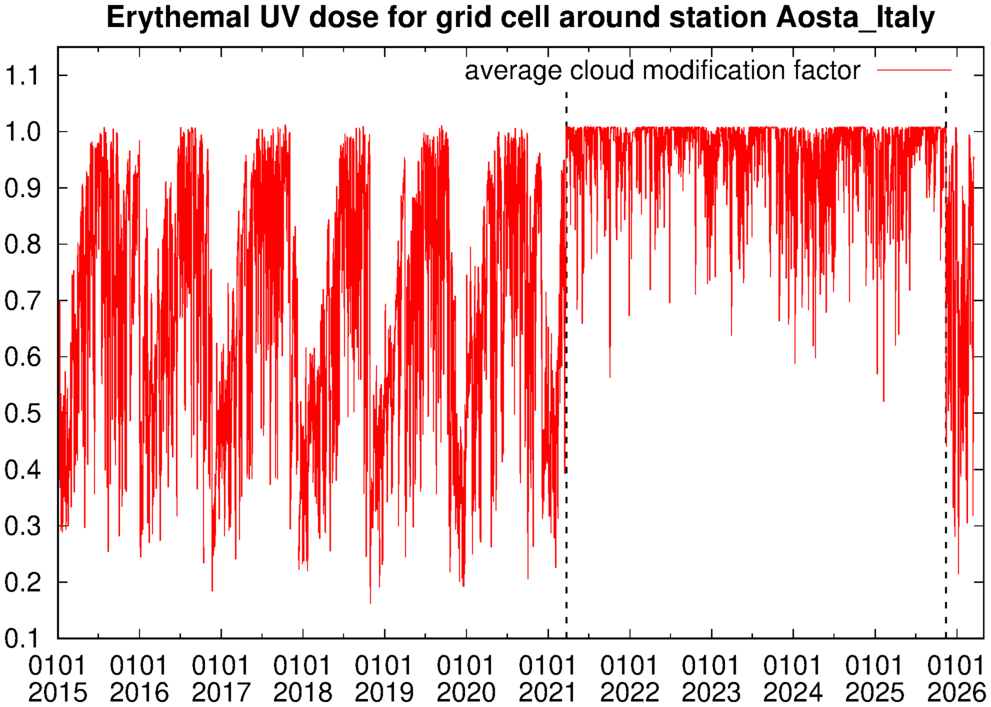
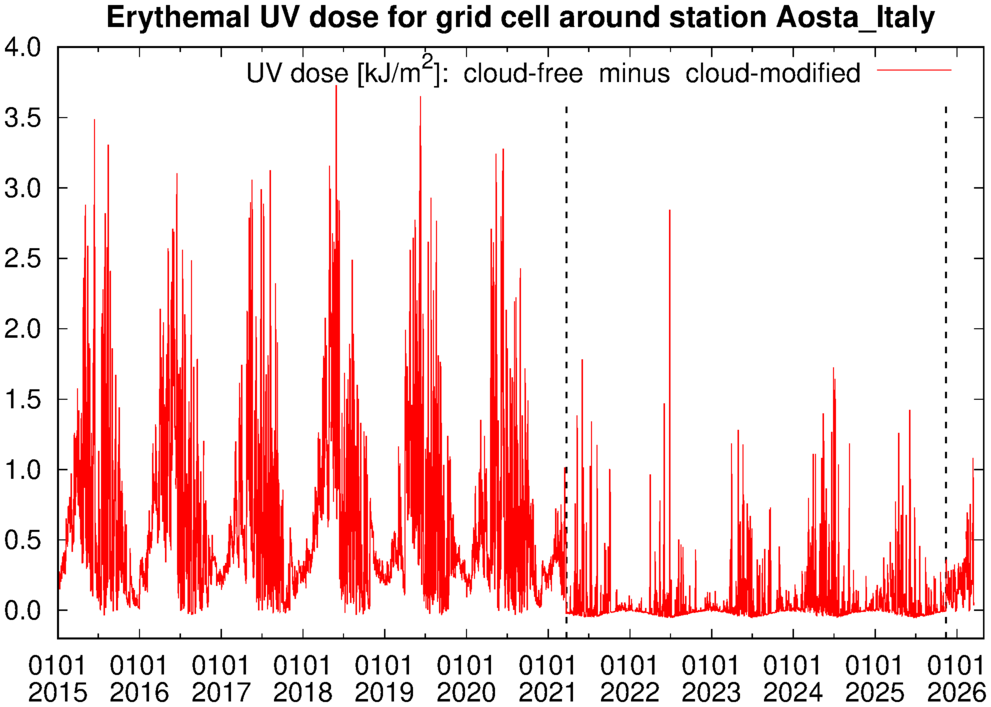
As an example, consider the cloud modification for the UV dose grid cell that contains the ground station Aosta in Italy:
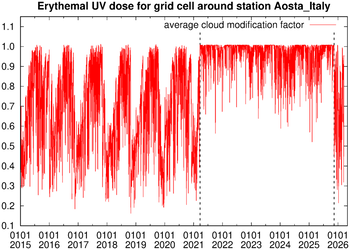
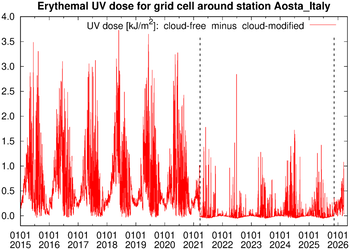
Daily average cloud modification factor (left) and the difference between the daily erythemal UV dose with and without cloud correction (right) for the UV grid cell within which the ground station Aosta (Italy) is located, which is (partly) covered by snow most of the year. The vertical dashed lines indicated moments when the MSG CPP algorithm was updated to try to improve handling cloud retrieval over snowy scenes: 22 March 2021 and 13 November 2025. This is somewhat of an extreme case shows that though the cloud retrieval before 22 March 2021 was not correct, the updated implemented was probably not giving reliable results either.
Impact of change from MSG to MTG data
[ to come ]
References:
- MSG/MTG-CPP product description
 last modified: 19 March 2026
data product contact:
Jos van Geffen & Michiel van Weele &
Ronald van der A
Copyright © KNMI / TEMIS